Friday, 13 June 2014

Charles Ashmore’s Trail

A ghost story

Ghost StoryThe family of Christian Ashmore consisted of his wife, his mother, two grown daughters, and a son of sixteen years.  They lived in Troy, New York, were well-to-do, respectable persons, and had many friends, some of whom, reading these lines, will doubtless learn for the first time the extraordinary fate of the young man.  From Troy the Ashmores moved in 1871 or 1872 to Richmond, Indiana, and a year or two later to the vicinity of Quincy, Illinois, where Mr. Ashmore bought a farm and lived on it.  At some little distance from the farmhouse was a spring with a constant flow of clear, cold water, whence the family derived its supply for domestic use at all seasons.

On the evening of the 9th of November in 1878, at about nine o'clock, young Charles Ashmore left the family circle about the hearth, took a tin bucket and started toward the spring.  As he did not return, the family became uneasy, and going to the door by which he had left the house, his father called without receiving an answer.  He then lighted a lantern and with the eldest daughter, Martha, who insisted on accompanying him, went in search.  A light snow had fallen, obliterating the path, but making the young mans trail conspicuous; each footprint was plainly defined.  After going a little more than half-way - perhaps seventy-five yards - the father, who was in advance, halted, and elevating his lantern stood peering intently into the darkness ahead.

What is the matter, father? the girl asked. This was the matter: the trail of the young man had abruptly ended, and all beyond was smooth, unbroken snow.  The last footprints were as conspicuous as any in the line; the very nail-marks were distinctly visible.  Mr. Ashmore looked upward, shading his eyes with his hat held between them and the lantern.  The stars were shining; there was not a cloud in the sky; he was denied the explanation which had suggested itself, doubtful as it would have been - a new snowfall with a limit so plainly defined.  Taking a wide circuit round the ultimate tracks, so as to leave them undisturbed for further examination, the man proceeded to the spring, the girl following, weak and terrified.  Neither had spoken a word of what both had observed.  The spring was covered with ice, hours old. Returning to the house they noted the appearance of the snow on both sides of the trail its entire length.  No tracks led away from it.

The morning light showed nothing more.  Smooth, spotless, unbroken, the shallow snow lay everywhere. Four days later the grief-stricken mother herself went to the spring for water.  She came back and related that in passing the spot where the footprints had ended she had heard the voice of her son and had been eagerly calling to him, wandering about the place, as she had fancied the voice to be now in one direction, now in another, until she was exhausted with fatigue and emotion.

Questioned as to what the voice had said, she was unable to tell, yet averred that the words were perfectly distinct.  In a moment the entire family was at the place, but nothing was heard, and the voice was believed to be an hallucination caused by the mothers great anxiety and her disordered nerves.  But for months afterward, at irregular intervals of a few days, the voice was heard by the several members of the family, and by others.  All declared it unmistakably the voice of Charles Ashmore; all agreed that it seemed to come from a great distance, faintly, yet with entire distinctness of articulation; yet none could determine its direction, nor repeat its words.  The intervals of silence grew longer and longer, the voice fainter and farther, and by midsummer it was heard no more.

If anybody knows the fate of Charles Ashmore it is probably his mother.  She is dead.

Wednesday, 11 June 2014

A Cold Greeting

A ghost story told by the late Benson Foley of San Francisco

Sanfrancisco1945In the summer of 1881 I met a man named James H. Conway, a resident of Franklin, Tennessee.  He was visiting San Francisco for his health, deluded man, and brought me a note of introduction from Mr. Lawrence Barting.  I had known Barting as a captain in the Federal army during the civil war.  At its close he had settled in Franklin, and in time became, I had reason to think, somewhat prominent as a lawyer.  Barting had always seemed to me an honourable and truthful man, and the warm friendship which he expressed in his note for Mr. Conway was to me sufficient evidence that the latter was in every way worthy of my confidence and esteem.  At dinner one day Conway told me that it had been solemnly agreed between him and Barting that the one who died first should, if possible, communicate with the other from beyond the grave, in some unmistakable way - just how, they had left (wisely, it seemed to me) to be decided by the deceased, according to the opportunities that his altered circumstances might present.

A few weeks after the conversation in which Mr. Conway spoke of this agreement, I met him one day, walking slowly down Montgomery street, apparently, from his abstracted air, in deep thought.  He greeted me coldly with merely a movement of the head and passed on, leaving me standing on the walk, with half-proffered hand, surprised and naturally somewhat piqued.  The next day I met him again in the office of the Palace Hotel, and seeing him about to repeat the disagreeable performance of the day before, intercepted him in a doorway, with a friendly salutation, and bluntly requested an explanation of his altered manner.  He hesitated a moment; then, looking me frankly in the eyes, said:

I do not think, Mr. Foley, that I have any longer a claim to your friendship, since Mr. Barting appears to have withdrawn his own from me - for what reason, I protest I do not know.  If he has not already informed you he probably will do so.

But, I replied, I have not heard from Mr. Barting. Heard from him! he repeated, with apparent surprise.  Why, he is here.  I met him yesterday ten minutes before meeting you.  I gave you exactly the same greeting that he gave me.  I met him again not a quarter of an hour ago, and his manner was precisely the same: he merely bowed and passed on.  I shall not soon forget your civility to me.  Good morning, or - as it may please you - farewell. All this seemed to me singularly considerate and delicate behaviour on the part of Mr. Conway.

As dramatic situations and literary effects are foreign to my purpose I will explain at once that Mr. Barting was dead.  He had died in Nashville four days before this conversation.  Calling on Mr. Conway, I apprised him of our friends death, showing him the letters announcing it.  He was visibly affected in a way that forbade me to entertain a doubt of his sincerity.

It seems incredible, he said, after a period of reflection.  I suppose I must have mistaken another man for Barting, and that mans cold greeting was merely a strangers civil acknowledgment of my own.  I remember, indeed, that he lacked Bartings moustache.

Doubtless it was another man, I assented; and the subject was never afterward mentioned between us.  But I had in my pocket a photograph of Barting, which had been enclosed in the letter from his widow.  It had been taken a week before his death, and was without a moustache.

Monday, 9 June 2014

My Own Experience Of Pipes

A guest post by Jasmine in Dublin.

Haunted DublinI read your post about Ghostwatch and thought it worth looking into further so I decided to read up about it on Wikipedia and strangely enough, the name Pipes is the name my mother gave to an entity we had in our house when I was younger. We’ve since moved from there but I’m wondering did she seen Ghostwatch and is that where she got the name from. Sadly my mother is no longer with us to ask her but it does make me wonder.
The house we lived in was in an old part of Dublin and had been owned by a Jewish family before us. They sold it on when they decided to move on and my parents were delighted to find somewhere they both really loved. We were fairly well off and this was before the times of the Celtic Tiger or anything like that. My dad, being a doctor worked long hours and my mother always seemed to be busy looking after me and my younger brother. We’d a lovely childhood and we loved the house. Looking back on it now, I guess you could say it had character.

As we grew up some things began to happen in the house which left us all puzzled. Things would go missing and of course we kids would get the blame. There seemed to be a habit of the windows opening on their own, or at least so my mother said. These were upstairs windows and heavy wooden frames too and we could never explain how they’d suddenly become open and a draft would be blowing through the house.

With old houses there’s always noise, creaking of floor boards or that but I remember it suddenly getting worse, like a rattling in various parts of the house, always when it was dark and quite unexpectedly. Myself and my brother became quite scared and this is where my mother came up with Pipes as a fictional character to make it less scary. Over time, the noises continued and my mother would smile and say “there’s Pipes”. There was no way this was water pipes or anything of the sort.

An interesting thing happened. I had friends in the neighbourhood as kids do and one evening while having dinner in my friend Danielle’s house, her mother overheard us talking. I was telling Danielle about Pipes and her mother seemed suddenly very interested and a little concerned. A few days later, I asked Danielle over and she told me her mother had said she wasn’t to be in the house because there were bad things in it. This was my house remember. She had told her that the previous family had been so scared they had moved off. I told my own mother this but she laughed it off.

The noises and strange happenings continued and eventually it got to the stage where my mother came and took myself and my brother in the middle of the night and brought us to my grandmothers. I just remember being so scared. I never went back to the house again and after a short stay in my granny's, we moved to the suburbs. As I grew older, my mother told me that she believed that there was something there, something quite evil and she couldn’t take it any more. She never tried to find out what it was because she hadn’t believed it to be anything to do with us specifically, more so the house itself. I’ve thought about maybe finding out about it but think maybe it’s just best left in the past. Just thought I’d share my story with you.

Saturday, 7 June 2014

Present At A Hanging

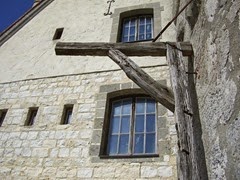
gallows-249833_640An old man named Daniel Baker, living near Lebanon, Iowa, was suspected by his neighbors of having murdered a peddler who had obtained permission to pass the night at his house.  This was in 1853, when peddling was more common in the Western country than it is now, and was attended with considerable danger.  The peddler with his pack traversed the country by all manner of lonely roads, and was compelled to rely upon the country people for hospitality.  This brought him into relation with queer characters, some of whom were not altogether scrupulous in their methods of making a living, murder being an acceptable means to that end.  It occasionally occurred that a peddler with diminished pack and swollen purse would be traced to the lonely dwelling of some rough character and never could be traced beyond.  This was so in the case of old man Baker, as he was always called.  (Such names are given in the western settlements only to elderly persons who are not esteemed; to the general disrepute of social unworth is affixed the special reproach of age.)  A peddler came to his house and none went away - that is all that anybody knew.

Seven years later the Rev. Mr. Cummings, a Baptist minister well known in that part of the country, was driving by Bakers farm one night.  It was not very dark: there was a bit of moon somewhere above the light veil of mist that lay along the earth.  Mr. Cummings, who was at all times a cheerful person, was whistling a tune, which he would occasionally interrupt to speak a word of friendly encouragement to his horse.  As he came to a little bridge across a dry ravine he saw the figure of a man standing upon it, clearly outlined against the gray background of a misty forest.  The man had something strapped on his back and carried a heavy stick - obviously an itinerant peddler.  His attitude had in it a suggestion of abstraction, like that of a sleepwalker.  Mr. Cummings reined in his horse when he arrived in front of him, gave him a pleasant salutation and invited him to a seat in the vehicle - if you are going my way,he added.  The man raised his head, looked him full in the face, but neither answered nor made any further movement.  The minister, with good-natured persistence, repeated his invitation.  At this the man threw his right hand forward from his side and pointed downward as he stood on the extreme edge of the bridge.  Mr. Cummings looked past him, over into the ravine, saw nothing unusual and withdrew his eyes to address the man again.  He had disappeared.  The horse, which all this time had been uncommonly restless, gave at the same moment a snort of terror and started to run away.  Before he had regained control of the animal the minister was at the crest of the hill a hundred yards along.  He looked back and saw the figure again, at the same place and in the same attitude as when he had first observed it.  Then for the first time he was conscious of a sense of the supernatural and drove home as rapidly as his willing horse would go.
On arriving at home he related his adventure to his family, and early the next morning, accompanied by two neighbors, John White Corwell and Abner Raiser, returned to the spot.  They found the body of old man Baker hanging by the neck from one of the beams of the bridge, immediately beneath the spot where the apparition had stood.  A thick coating of dust, slightly dampened by the mist, covered the floor of the bridge, but the only footprints were those of Mr. Cummings horse.

In taking down the body the men disturbed the loose, friable earth of the slope below it, disclosing human bones already nearly uncovered by the action of water and frost.  They were identified as those of the lost peddler.  At the double inquest the coroners jury found that Daniel Baker died by his own hand while suffering from temporary insanity, and that Samuel Morritz was murdered by some person or persons to the jury unknown.

Thursday, 5 June 2014

The Marquis de Rambouillet

A ghost story

The Marquis de Rambouillet, eldest brother of the Duchess of Montauzier, and the Marquis de Precy, eldest son of the family of Nantouillet, both of them between twenty and thirty, were intimate friends, and went to the wars, as in France do all men of quality. As they were conversing one day together on the subject of the other world, they promised each other that the first who died should come and bring the news to his companion. At the end of three months the Marquis de Rambouillet set off for Flanders, where the war was then being carried on; and de Precy, detained by a high fever, remained at Paris. Six weeks afterwards de Precy, at six in the morning, heard the curtains of his bed drawn, and turning to see who it was, he perceived the Marquis de Rambouillet in his buff vest and boots; he sprung out of bed to embrace him to show his joy at his return, but Rambouillet, retreating a few steps, told him that these caresses were no longer seasonable, for he only came to keep his word with him; that he had been killed the day before on such an occasion; that all that was said of the other world was certainly true; that he must think of leading a different life; and that he had no time to lose, as he would be killed the first action he was engaged in.

It is impossible to express the surprise of the Marquis de Precy at this discourse; as he could not believe what he heard, he made several efforts to embrace his friend, whom he thought desirous of deceiving him, but he embraced only air; and Rambouillet, seeing that he was incredulous, showed the wound he had received, which was in the side, whence the blood still appeared to flow. After that the phantom disappeared, and left de Precy in a state of alarm more easy to comprehend than describe; he called at the same time his valet de chambre, and awakened all the family with his cries. Several persons ran to his room, and he related to them what he had just seen. Everyone attributed this vision to the violence of the fever, which might have deranged his imagination; they begged of him to go to bed again, assuring him that he must have dreamt what he told them.

The Marquis, in despair, on seeing that they took him for a visionary, related all the circumstances I have just recounted; but it was in vain for him to protest that he had seen and heard his friend, being wideawake; they persisted in the same idea until the arrival of the post from Flanders, which brought the news of the death of the Marquis de Rambouillet.

This first circumstance being found true, and in the same manner as de Precy had said, those to whom he had related the adventure began to think that there might be something in it, because Rambouillet having been killed precisely on the eve of the day he had said it, it was impossible de Precy should have known of it in a natural way. This event having spread in Paris, they thought it was the effect of a disturbed imagination, or a made-up story; and whatever might be said by the persons who examined the thing seriously, there remained in people's minds a suspicion, which time alone could disperse: this depended upon what might happen to Marquis de Precy, who was threatened that he should be slain in the first engagement; thus everyone regarded his fate as the dénouement of the piece; but he soon confirmed everything they had doubted the truth of, for as soon as he recovered from his illness he would go to the combat of St Antoine, although his father and mother, who were afraid of the prophecy, said all they could to prevent him; he was killed there, to the great regret of all his family.

Tuesday, 3 June 2014

A Bloody Footstep

A ghost story

Smithills_Hall_1On the threshold of one of the doors of Smithills Hall there is a bloody footstep impressed into the door-step, and ruddy as if the bloody foot had just trodden there; and it is averred that, on a certain night of the year, and at a certain hour of the night, if you go and look at the door-step you will see the mark wet with fresh blood. Some have pretended to say that this appearance of blood was but dew; but can dew redden a cambric handkerchief? Will it crimson the finger-tips when you touch it? And that is what the bloody footstep will surely do when the appointed night and hour come round.

It is needless to tell you all the strange stories that have survived to this day about the old Hall, and how it is believed that the master of it, owing to his ancient science, has still a sort of residence there and control of the place, and how in one of the chambers there is still his antique table, and his chair, and some rude old instruments and machinery, and a book, and everything in readiness, just as if he might still come back to finish some experiment.

One of the chief things to which the old lord applied himself was to discover the means of prolonging his own life, so that its duration should be indefinite, if not infinite; and such was his science that he was believed to have attained this magnificent and awful purpose.

The object of the Lord of Smithills Hall was to take a life from the course of Nature, and Nature did not choose to be defrauded; so that, great as was the power of this scientific man over her, she would not consent that he should escape the necessity of dying at his proper time, except upon condition of sacrificing some other life for his; and this was to be done once for every thirty years that he chose to live, thirty years being the account of a generation of man; and if in any way, in that time, this lord could be the death of a human being, that satisfied the requisition, and he might live on.

There was but one human being whom he cared for—that was a beautiful kinswoman, an orphan, whom his father had brought up, and dying, left to his care. He saw that she, if anyone, was to be the person whom the sacrifice demanded, and that he might kill twenty others without effect, but if he took the life of this one it would make the charm strong and good.... He did slay this pure young girl; he took her into the wood near the house, an old wood that is standing yet, with some of its magnificent oaks, and there he plunged a dagger into her heart.

He buried her in the wood, and returned to the house; and, as it happened, he had set his right foot in her blood, and his shoe was wet in it, and by some miraculous fate it left a track all along the wood-path, and into the house, and on the stone steps of the threshold, and up into his chamber. The servants saw it the next day, and wondered, and whispered, and missed the fair young girl, and looked askance at their lord's right foot, and turned pale, all of them.

Next, the legend says, that Sir Forrester was struck with horror at what he had done and fled from his old Hall, and was gone full many a day. But all the while he was gone there was the mark of a bloody footstep impressed upon the stone door-step of the Hall. The legend says that wherever Sir Forrester went, in his wanderings about the world, he left a bloody track behind him. Once he went to the King's Court, and, there being a track up to the very throne, the King frowned upon him, so that he never came there any more. Nobody could tell how it happened; his foot was not seen to bleed, only there was the bloody track behind him.

At last this unfortunate lord deemed it best to go back to his own Hall, where, living among faithful old servants born in the family, he could hush the matter up better than elsewhere. So home he came, and there he saw the bloody track on the door-step, and dolefully went into the Hall, and up the stairs, an old servant ushering him into his chamber, and half a dozen others following him behind, gazing, shuddering, pointing with quivering fingers, looking horror-stricken in one another's pale faces.

By and by he vanished from the old Hall, but not by death; for, from generation to generation, they say that a bloody track is seen around that house, and sometimes it is traced up into the chambers, so fresh that you see he must have passed a short time before.

This is the legend of the Bloody Footstep, which I myself have seen at the Hall door.

Sunday, 1 June 2014

If These Walls Could Talk: The Stone Tape Theory Of Ghosts

Guest post by Robert Buchanan

Stone Tape Ghosts

To clarify a few things. I do not believe in an afterlife. I do however believe that images, sounds and sensations from the past can be recorded in matter as energy and played back. One of the reasons I believe this is every day I see images and hear sounds from the dead in the form of television and radio. Actors and singers who have long since bit the dust are resurrected in photons and electrons for our pleasure on television and the radio. Yes these are not interactive, they are just unintelligent echos, recorded electronically. But a surprising amount of reported ghosts in so called “residual haunting” share many of the qualities of our artificially recorded snapshots of the past.

In a world permeated by invisible signals like WiFi and EMF leakage its more credible than ever that another invisible dimension of reality might be overlaying normal life. In this article I’m going to discuss the “Stone Tape Theory” of residual hauntings. The theory has yet to be proven so for the most part this is speculation yes,but exploring the possibilities of a scientific explanation for ghost sightings should not be taboo. Any extraordinary alleged phenomena requires extraordinary proof, but that potential proof will never be found if science merely dismisses the possibility of the existence of the phenomena we now call ghosts.

The idea that environmental factors might trap and replay phantom images is around longer than the advent of video and audio recordings. As early as the 19th Century Sir William Barrett, who was a scientist and founding member of the Society for Psychical Research, speculated about the possibility. The expression ‘Stone Tape ’ was first coined in a BBC play of the same name from 1972. The Stone Tape theory speculates that materials in the environment can trap representations of events in time the same way that a video camera can. For example Iron oxide particles, essentially rust, which are used in old video and audio taping equipment, might work in concert with the crystalline structure of some types of stone. Another theorized method for storage and playback of information echoes of past experiences is water. It’s not as far fetched as it might initially sound. Ambient water in the materials could act as a substrate capable working in tandem with the mineral and metal content of the location. Water is pervasive in practically all building materials not to mention in human bodies and in the ground.Water is often ionized and when agitated it can produce, amplify and transmit an electric charge at varying levels.

Stone Tape Theory

This might even account for how disturbing an old building during renovation work might release trapped moisture bearing charges. The slowly evaporating water corresponds also with the reported fading of apparitions over time. Interestingly materials used in the storage of electromagnetic data are found in abundance in some of the stereotypically “haunted” locations such as old stone castles, state institutions and historic houses. It does seem as if residual hauntings have a limited lifespan, and even the ghosts themselves seem to chromatically fade over time, changing colour. Could the numerous accounts of “headless” or “floating” ghosts be less to do with some spooky mutilation and more to do with the extremities of the image wearing and fading with time like an old photograph?  The cliché of “grey ladies” which are in abundance in ghost stories of the UK might have less to do with grey being a fashionable colour in the afterlife and more to do with the fact that there was a large amount of ghosts generated during a particular point in history whose time in the past corresponded to their images fading to grey by the start of the twenty first century.

To speculate how this might occur, we can conjecture that it requires a concert of specific conditions, otherwise we would find ourselves on a planet crowded with more ghosts than the living. Perhaps we are, but its only the visible ones which Stone Tape theory is concerned with. Three main elements are at play. Firstly the location. This creates the right ecology to enable playback. Certain building and environmental materials and conditions. Secondly the catalyst for making the human brain imbed some type of image on the surroundings.This opens the fascinating area of “crisis apparitions” where people see the images of loved ones at a moment of extreme distress or near death. The person could be on the other side of the world. Obviously if there witness is aware that their loved one was near death due to sickness or is very elderly than perhaps stress or bereavement could create a hallucination anticipating their demise. Likewise a lot of the crisis apparitions reported during wartime might be just caused my worry about the very likely danger the other is in. However there sheer volume of reports and the often bizarre and surprising features make it interesting. One could imagine some kind of biological process where by a persons brain unconsciously transmits some kind of electromagnetic signal at a moment of mortal danger which is picked up like some kind of spiritual Skype by the person they are most intimate with. The stone tape theory requires neither the existence of the afterlife no any supernatural forces. It simply involves an extension of natural phenomena and an interaction of matter and radiation, an as yet unexplained interplay between the human brain and the environment.

Stone Tape EMF

So we have the environmental conditions sympathetic to receiving and storing these experiences and we have the traumatic event which is recorded, now the third element, playback. Perhaps it’s great trauma or an individual whose life experiences make them particularly empathic to the person. Perhaps it a natural but so far undetected sense the brain has. Disruption and construction work at haunted locations are frequently cited as a stimulus for haunting.These might agitate or release something trapped in the materials of the building analogous to how asbestos can be or even electrical leakage by faulty wiring can be released during renovations. Whatever the trigger the unwitting witness suddenly finds themselves confronted by a playback of audio or visual from a long dead source, a ghost.

In a universe governed by quantum physics and warped space time we’re not even sure there really is any difference between the past and the future. Again, the Stone Tape Theory requires neither an afterlife nor an intelligence behind the existence of ghosts. Residual haunting may be just recordings, as demonstrated by the often seemingly illogical behaviour of the spectres walking through walls where perhaps a door had previously been etc.This indicates again an affinity for a particular location as opposed to having any real knowledge that it is being observed.

Millions of people are seeing this phenomena. They can not all be hallucinating or lying. If it is mundane to us that visual and audio representations of the living and the dead can already be recorded by transferring electromagnetic radiation (images in to video) and sound (voices on to magnetic magnetic tape) then it is neither an impossible leap or even a very unlikely one to forward the hypothesis that images of long past events and people might somehow be recorded in the environment.

Ghosts

See more from Robert - http://theloosecannonbuchanan.tumblr.com/

Twitter - @RobLooseCannon

Facebook - https://www.facebook.com/rob.l.buchanan.5